Key takeaways
- Mining asset tracking system combines RFID, GPS and IoT sensors to show where people, vehicles, tools and equipment are, continuously.
- RFID covers close-range and zone tracking, GPS covers fleet and open areas, and IoT sensors cover air quality, equipment condition and structural data.
- Zone-level accuracy is enough for most sites. Blasting areas and confined spaces need denser readers. Bluetooth technology can be used.
- The same entry/exit hardware that handles shift change becomes a live evacuation roll call.
- IoTMineTracker solution eliminates manual search loops in confined or remote environments. Industrial benchmarks show that tracking solutions cut the time spent locating assets from 30–45 minutes per shift to under 5 minutes.
What is mining asset tracking?
Mining asset tracking is a system that uses RFID tags, GPS units and IoT sensors to locate and monitor workers, vehicles, tools and equipment across a mine site in real time. It replaces sign-in sheets, radio check-ins and handover notes with live data on who is where and what is running.
It typically covers:
-
- Personnel: RFID badges with zone-level location and digital attendance
-
- Vehicles and heavy equipment: GPS on haul trucks, loaders and drills, with usage and maintenance data per unit
-
- Tools and consumables: tagged and tracked like the large equipment
-
- Containers, trailers and site inventory: often untracked until something goes missing
Everything runs on one platform instead of four unsynced spreadsheets. The IoTMineTracker platform supports all mining assets, personnel and inventory items tracking using tested and state of the art technology stack.
Why do paper and radio tracking fail underground?
Paper and radio systems fail because they depend on people remembering to report. They can’t confirm location on their own. A whiteboard works for ten people and three trucks. It breaks when the crew doubles, and radios often don’t work two hundred feet down.
Common failures:
-
- Nobody can say with certainty who was in a hazard zone at a given time.
-
- Machines sit idle for a week because nobody flagged them as free.
-
- Records live in three binders across two offices when an inspector arrives.
-
- Tools such as grinders and drill bits go missing and are re-ordered instead of found.
Most crews take safety seriously. The infrastructure just can’t answer “who was underground at 6:14 a.m.?” fast enough when it matters, and regulators won’t accept “we’re pretty sure.”
Why does equipment downtime cost a mine more than the repair bill?
Equipment downtime costs a mine more than the repair because one stopped machine idles everything that depends on it. A parked haul truck holds up loaders, crushers and the crews waiting on them, and the lost output usually outweighs the cost of the fix.
The costs stack up in four places:
-
- Lost production hours on the machine and on every process downstream of it
-
- Idle crew time, with people paid but waiting
-
- Missed shift and delivery targets that push work into the next cycle
-
- Deferred maintenance debt, because a rushed repair today delays the planned service due tomorrow
The average cost of an idle heavy-duty crane in a site operation is approximately $125 per hour
What causes unplanned equipment downtime in mining?
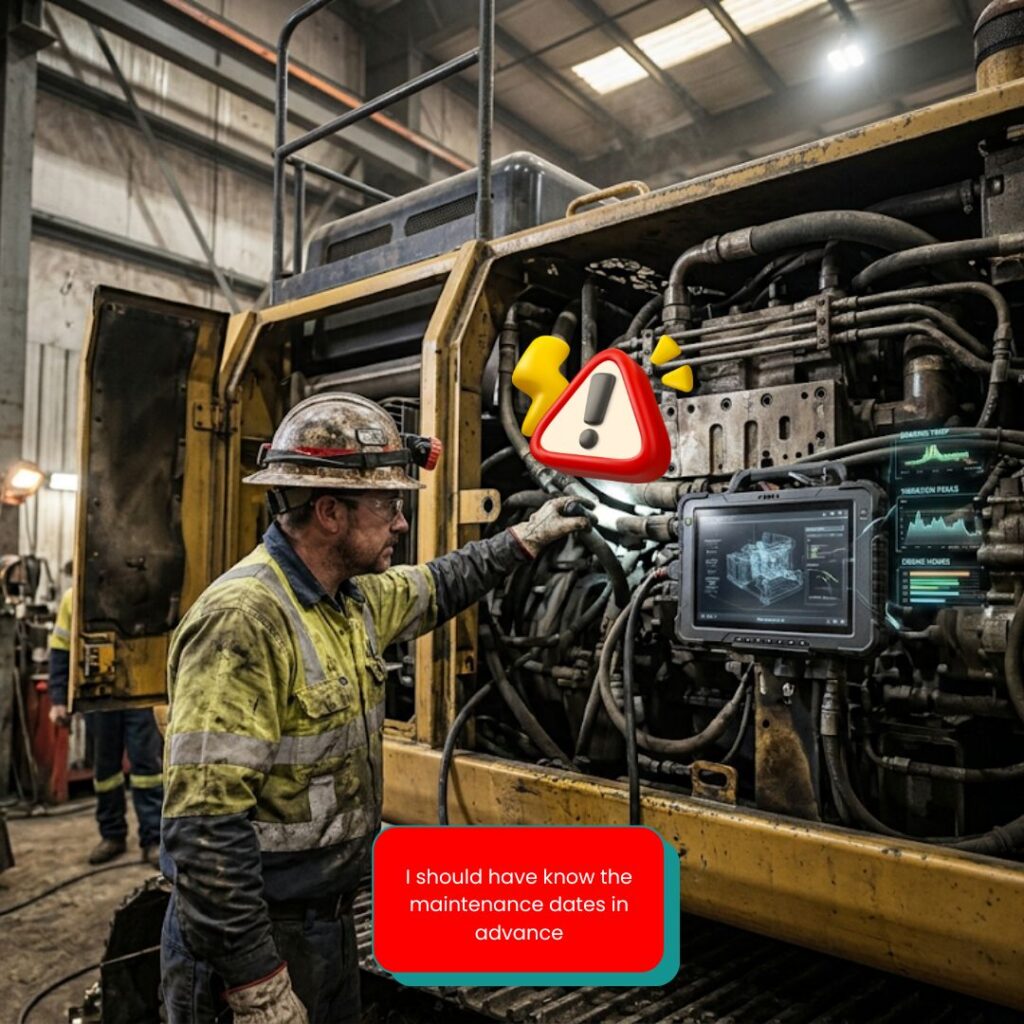
The most common causes are missed maintenance, time spent locating machines, and service records that are too scattered to show patterns. All three come from relying on calendars and memory instead of live data.
| Cause | What happens | What tracking changes |
|---|---|---|
| Calendar-based servicing | A machine worked hard hits its limit before the next date on the schedule | Service triggers follow actual engine hours or cycles |
| Time lost finding the machine | The service crew drives around the site before the work can start | Live location is on the dashboard before the crew leaves |
| Fragmented records | Repeat failures go unnoticed across shifts, paper forms and spreadsheets | One service history per asset, searchable by component |
A maintenance team that spends an hour finding a machine has lost an hour of repair capacity. On a large site, that adds up quickly. Mining equipment tracking removes that lost hour by showing every machine’s location and service history in one place.
What hardware does mining asset tracking use?
No single device does the job. RFID in mining works alongside GPS and IoT sensors:
| Technology | Best for | Why it works underground |
|---|---|---|
| RFID tags and readers | Badges, tools, equipment, zone and gate tracking | Survives dust and vibration; a barcode sticker gets scraped off a rack in a week |
| GPS units | Haul trucks, loaders, drills, wide-open areas | Reports location around the clock where fixed readers would be uneconomical |
| IoT sensors on a wireless mesh | Air quality, equipment condition, structural indicators | Mesh networks handle interference and dead zones; surface Wi-Fi doesn’t reach three levels down |
RFID for close range, GPS for open stretches, sensors for the environmental data neither can capture.
How accurate does an underground mine tracking system need to be?
Zone-level accuracy is enough for most mine sites. A mine personnel tracking system with readers at zone boundaries shows which section a worker is in. That supports evacuation calls, shift accountability and alerts for people entering restricted areas.
For blasting zones and confined spaces, use either:
-
- Denser reader placement, or
-
- A reverse setup where the worker carries the reader and tags are fixed at known points. It costs less and gives finer resolution where it matters.
How does a mine safety tracking system speed up entry, exit and evacuation?
High-speed readers scan a stack of badges at once, so a bus of forty workers registers in seconds instead of ten minutes at the gate.
In an evacuation, the same gate hardware becomes a live roll call. It shows who has reached the surface and who is still unaccounted for underground. A paper list can’t keep up.
How do underground sensors and alerts work?
A network of sensors and a dedicated wireless backbone monitor conditions and worker positions continuously. When a reading crosses a safety threshold, the alert reaches the operations center at the same moment as the person nearby. The operations center can be on-site or at a regional command post hundreds of miles away.
What does GPS tracking for mining equipment give operations?
GPS tracking is the core of mining fleet management, giving operations teams continuous visibility into high-value vehicles. Haul trucks and drills are major capital assets, and idle time or rough handling is money leaking out unnoticed.
-
- Live location on every vehicle, with no waiting for a shift report typed hours later
-
- Driver behavior alerts for speed, idling and route deviation
-
- Maintenance based on actual run hours, not calendar dates
-
- Automatic Hours of Service and Daily Vehicle Inspection Report data
-
- Spare parts tracking, so the part is often already on the shelf when a truck goes down
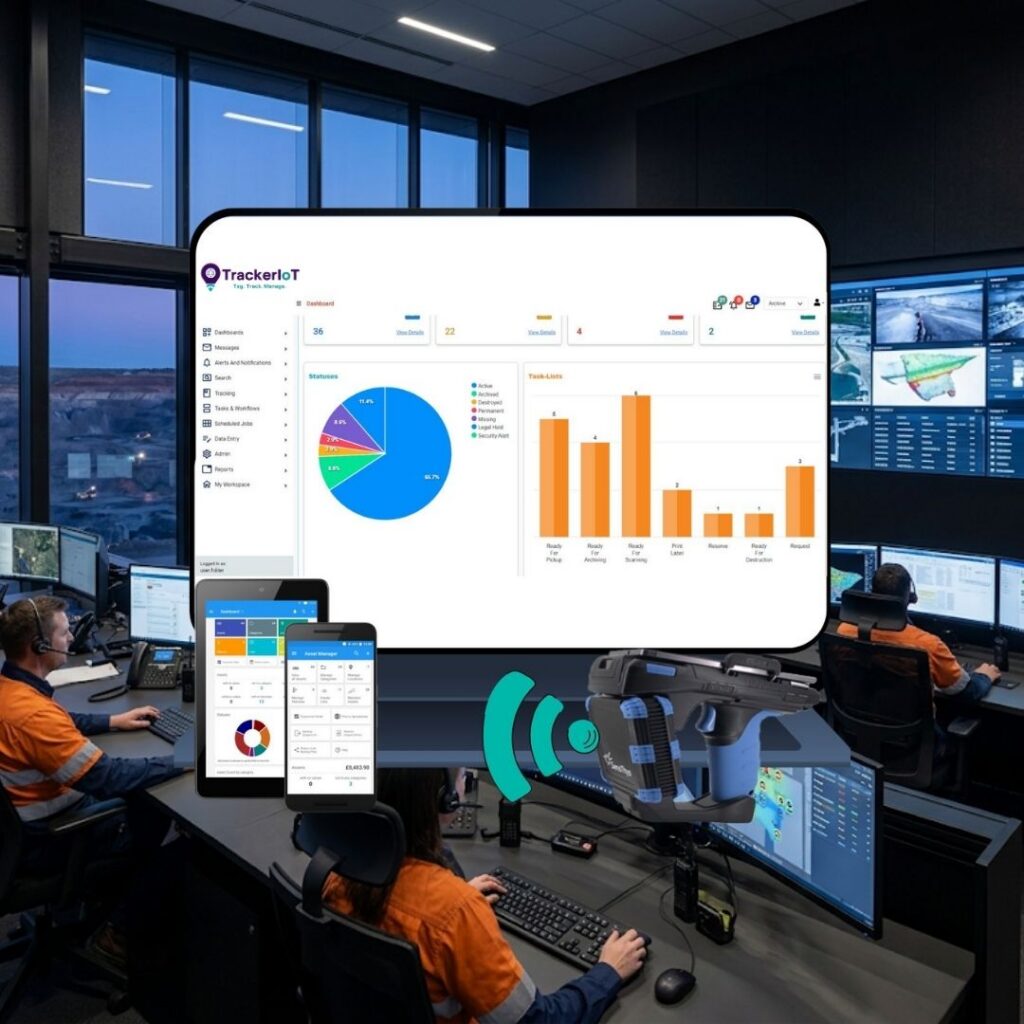
What do the data and dashboards actually reveal?
A single tag read or location ping means nothing. A few thousand of them on a dashboard show patterns:
-
- Attendance trends
-
- Which equipment earns its keep
-
- Fuel burn that doesn’t match the route
-
- A maintenance backlog building in one corner of the fleet
That is how decisions move from Monday-meeting gut feel to evidence.
What the typical vendor comparisons don’t tell you
-
- The most common reader-placement mistake is the directionality of the readers. Just placing readers in the zone doesn’t work. Configuration of RFID readers is key here.
-
- To completely execute a project including requirement analysis can take up to 2-3 months. This is not just a plug and play model.
-
- The working of the system depends on the data quality and format. Our team helps you in deciding the data points like employee no, asset name and sr nos. etc. So identifying the data points for tracking is extremely important which very few vendors can do perfectly.
How is a mining asset tracking system built?
It is built in three layers, from the surface gate to the working face:
-
- Tags and sensors on people, vehicles and critical equipment
-
- Readers and gateways, fixed and mobile, that capture data and send it over a network built for underground conditions
-
- One central platform that turns every stream into maps, dashboards, alerts and history
The system ships ready to run, then is configured to the site’s security and reporting rules.
How do you choose a mining asset tracking vendor?
Choose a vendor with real mine-site experience. Check for:
-
- One platform for RFID, GPS and sensor data, not three logins and three support lines
-
- Hardware rated for dust, moisture and vibration, not office equipment pressed into service
-
- Training and installation included, so the crew is running the system on day one
-
- Configuration for your site type: hard-rock, open-pit, quarry, ore processing or a remote fly-in camp.
Connected tracking won’t fix everything on a site, but it answers three questions fast: who’s here, where’s the gear, and is anyone missing.
Eric Collins, CEO, Tracker IoT LLC
What a real before-and-after looks like
| Metric | Before tracking | After tracking |
|---|---|---|
| Unplanned downtime | 30% | ~2% |
| Equipment availability | 60% | 95% |
| Audit preparation time | 15 Days | Within minutes |
| Time to locate a machine for service | 1 Day | Within minutes |

About the Author
Eric Collins has been designing and implementing tracking systems along with records management solutions since 1984. Extensive experience in local, state and federal governments, police and military, and many commercial industries and applications. Twice certified by the prestigious Institute of Certified Records Managers (www.icrm.org). Holder of U.S. patent for ‘novel records management solution’. Inventor of the file management industry’s first Internet file and archive label printing system, released in 1998, and which gained #1 global market share for file labelling solutions. Currently founder and CEO of TrackerIoT, a leading global tracking system vendor specializing in file management solutions.
Contact eric@trackeriot.com or +1 941.375.9437.