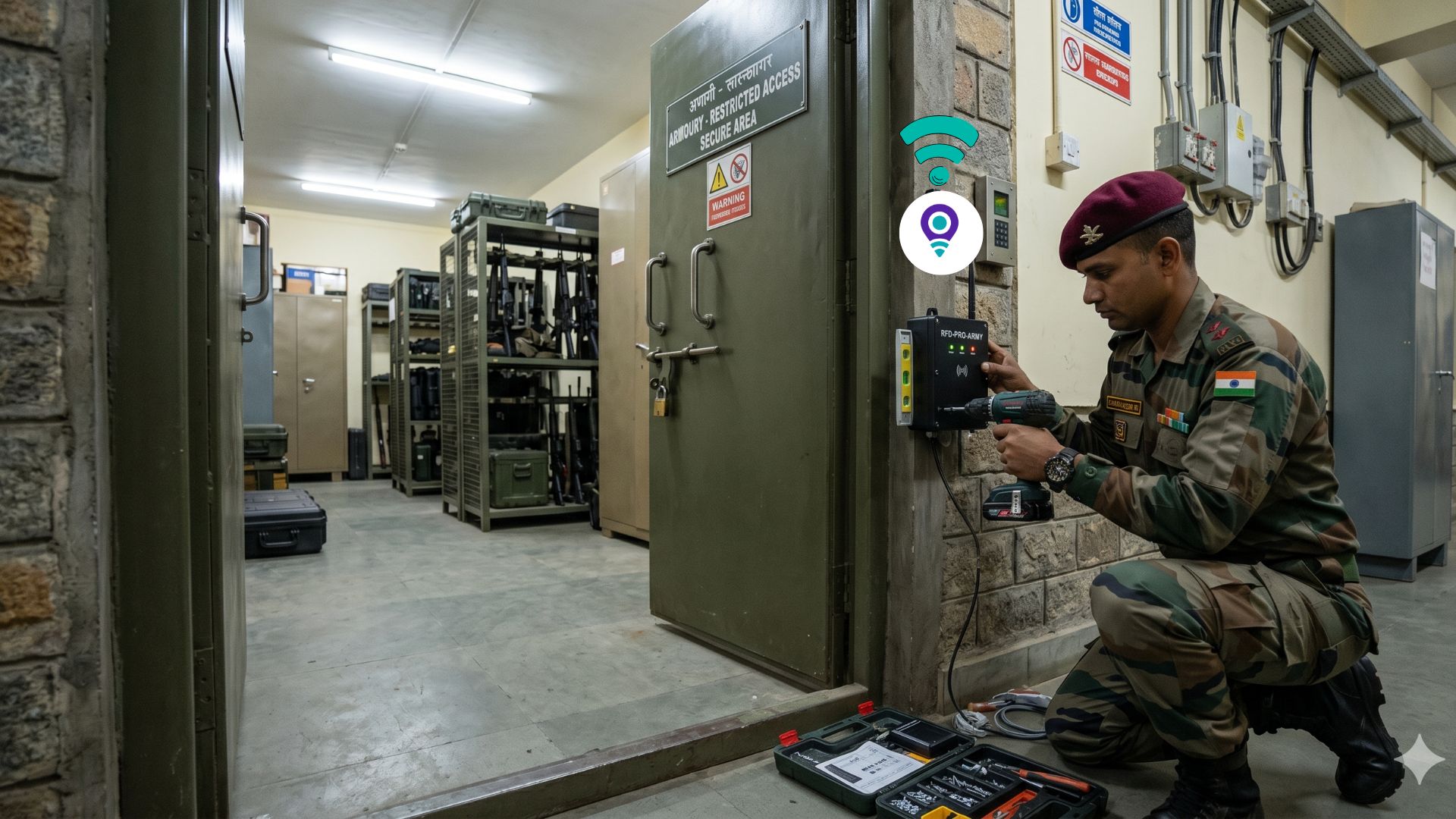
In an era where security and accountability are paramount, the manual clipboard and paper logbook are no longer enough. For law enforcement, military units, and private security firms, the stakes of losing track of a single asset are incredibly high.
Firearm weapon tracking has evolved from a simple inventory task into a high-tech ecosystem of real-time monitoring and automated data capture. This guide explores how modern tracking devices and software are transforming armory operations.
What is Firearm Weapon Tracking?
At its core, a firearm tracking system is a combination of hardware and software designed to monitor the location, status, and chain of custody of weapons in real-time. By utilizing technologies like GPS, GSM, and RFID weapon tracking system, these systems replace human error with digital precision, ensuring that every weapon is accounted for from the moment it leaves the rack to the moment it is returned.
At its simplest, this is the digital “eyes and ears” of an armory. It’s a specialized ecosystem that combines IoT (Internet of Things) hardware with centralized management software.
- Beyond the Serial Number: Traditional tracking involves a human reading a serial number and writing it down. Digital tracking assigns a unique “digital twin” to every weapon.
- The Chain of Custody: It creates an unalterable digital trail. You don’t just know where the weapon is; you know who had it last, when it was serviced, and how long it has been out in the field.
1. The Synergy: Hardware vs. Software
A tracking system is useless if the hardware can’t communicate, or if the software has no data to process.
- The Hardware (The Sensors): Embed RFID tags in the grip of each rifle, attach GPS “pucks” to transport cases, and mount fixed antennas on armory doors. They act as the “eyes” that see the movement.
- The Software (The Brain): This is the centralized database. It stores the “Digital Twin” of every weapon. When a piece of hardware “sees” a gun move, the software records the timestamp, identifies the user, and updates the inventory level instantly.
2. The Three Pillars of Monitoring
The text mentions monitoring Location, Status, and Chain of Custody. Each serves a specific security purpose:
A. Location (Where is it?)
- Indoor: Using RFID, the system knows if a weapon is in “Rack A” or “Cleaning Station B.”
- Outdoor: Using GPS, the system knows if a patrol rifle is currently in a vehicle at a specific street intersection.
B. Status (What is its condition?)
Tracking isn’t just about “where”; it’s about “readiness.” The system monitors:
- Availability: Is the weapon ready for issue, or is it “Red-Tagged” for repair?
- Maintenance Cycles: How many rounds have been fired? Is it due for an armorer’s inspection?
C. Chain of Custody (Who has it?)
This is the most critical legal aspect. The system creates an unalterable log:
- The Hand-off: “Officer Smith checked out Glock #12 at 06:00 AM.”
- The Return: “Officer Smith returned Glock #12 at 18:00 PM.”
- Evidence: In a legal scenario, this digital trail proves exactly who was responsible for a specific weapon at a specific second.
How the Technology works
To truly understand how firearm weapon tracking works, you have to look past the individual gadgets and see the system architecture. It functions as a “Layered Defense” where each technology handles a specific environment—indoor, outdoor, and the communication bridge between them.
RFID: The “Bulk Inventory” Specialist
Inside the armory, individual GPS tracking is overkill and battery-draining. This is where RFID (Radio Frequency Identification) dominates.
- The Technology (Backscatter): Most systems use Passive UHF (Ultra High Frequency) tags. These tags have no battery. Instead, they contain a tiny antenna and a microchip. When an RFID reader (at a doorway or window) sends out radio waves, the tag “harvests” that energy to power itself just long enough to reflect a signal back with its unique ID. This is called backscatter.
- The “Invisible” Workflow: Because RFID doesn’t require “line-of-sight” like a barcode, an armorer can scan a rack of 50 weapons in seconds by just walking past them.
- Issue & Return: At the armory window, fixed antennas create a “read zone.” As a weapon passes through, the software automatically matches that weapon’s ID to the officer’s ID card (often using BLE or Bluetooth Low Energy), logging the transaction without a single keystroke.
GPS: The “Precision” Tracking worldwide
Once a weapon leaves the building and enters the “wide world,” RFID becomes useless because its range is limited to about 30 feet. This is when the GPS (Global Positioning System) module wakes up.
- Satellite Trilateration: The tracking device (discreetly embedded in the weapon’s grip, buttstock, or as a magazine extension) communicates with a network of 24+ satellites. By measuring the time it takes for signals to arrive from at least four satellites, the device calculates its exact latitude, longitude, and altitude.
- Smart Power Management: To save battery, these devices often use motion sensors (accelerometers). The GPS only “pings” its location when the weapon is moving. When the weapon is stationary in a locker, the GPS goes into “deep sleep,” allowing the battery to last up to 6 months.
- High-Stakes Recovery: If a weapon is lost or stolen, the GPS provides the “Digital Breadcrumbs” needed for recovery, accurate to within a few meters.
GSM: The “Communication” Messenger
GPS can find a location, but it has no way to tell you where it is. It is a receiver, not a transmitter. GSM (Global System for Mobile Communications) is the voice of the system.
- The Cellular Link: The tracking device contains a specialized SIM card. It uses the same cellular infrastructure as your mobile phone to “upload” the coordinates gathered by the GPS to a cloud-based Command Center.
- Real-Time Data Packets: Instead of a constant stream (which would drain the battery), the GSM module sends small “data packets” at specific intervals or when triggered by an event.
- Alert Routing: This is the most critical function. If a sensor detects a “Security Event”—such as a weapon leaving a geofenced area or a “Shots Fired” detection—the GSM module bypasses standard intervals to send an immediate “Priority Alert” to the supervisor’s dashboard and mobile devices.
How They Work in Synergy
The true power of Firearm Weapon Tracking is the seamless transition between these layers:
| Environment | Primary Tech | Human Action Required | Result |
| In Storage | RFID | None (Passive) | 100% accurate daily audits in minutes. |
| At the Window | RFID + BLE | Walking through | Instant digital “Chain of Custody” log. |
| In the Field | GPS | Movement | Real-time map visibility for commanders. |
| Security Breach | GSM | None (Automatic) | Instant SMS/Email alerts for theft or misuse. |
Deep Dive into Key Features
These features turn a simple “locator” into a comprehensive security system.
Real-Time Issue & Return
This is about speed and accuracy. In a shift change, 50 officers might need to gear up in 15 minutes.
- Automated Logging: As an officer walks past a sensor with their rifle, the system automatically checks it out to their name.
- Visual Verification: Systems like WeaponTrackerIoT can trigger a camera to snap a photo of the person carrying the weapon, adding a layer of biometric accountability.
Geofencing: The Digital Perimeter
Think of this as an invisible “leash.” You can draw a circle around a police precinct or a training range on a digital map.
- The Logic: If Weapon #402 crosses that line without authorization, the system immediately sends a push notification or email to the Armory Manager.
Tamper Alerts
Manufacturers often integrate tracking devices into the weapon’s grip or a specialized attachment.
- Sensors: These devices can detect if they are being unscrewed or if the “seal” is broken.
- Instant Response: The moment a tamper is detected, the GSM module sends a “Distress Signal,” allowing for immediate recovery efforts.
Sector-Specific Benefits
Why do different industries care? Their “pain points” are different:
- Law Enforcement: Their biggest risk is litigation and loss. If a weapon is used in a crime after being lost or stolen, the department needs to prove they had “Best-in-Class” tracking protocols in place to limit liability.
- Military: Their biggest challenge is volume. Accounting for 5,000 rifles during a base-wide audit is a nightmare. RFID reduces “Audit Time” from days to mere hours.
- Private Security: They use tracking for compliance. Firms that secure their firearms in smart safes and track them 24/7 often receive lower insurance premiums.
The IoTWeaponTracker Edge
The blog concludes by highlighting WeaponTrackerIoT’s 17 years of experience. In the world of security tech, “new” isn’t always better; “proven” is.
- Customization: No two armories are the same. A system must be able to adapt—tracking not just guns, but also night-vision goggles, radios, and even ammunition crates.
- Accountability: The goal is 100% accuracy. In this industry, 99% accuracy means one weapon is missing—and that is one too many.