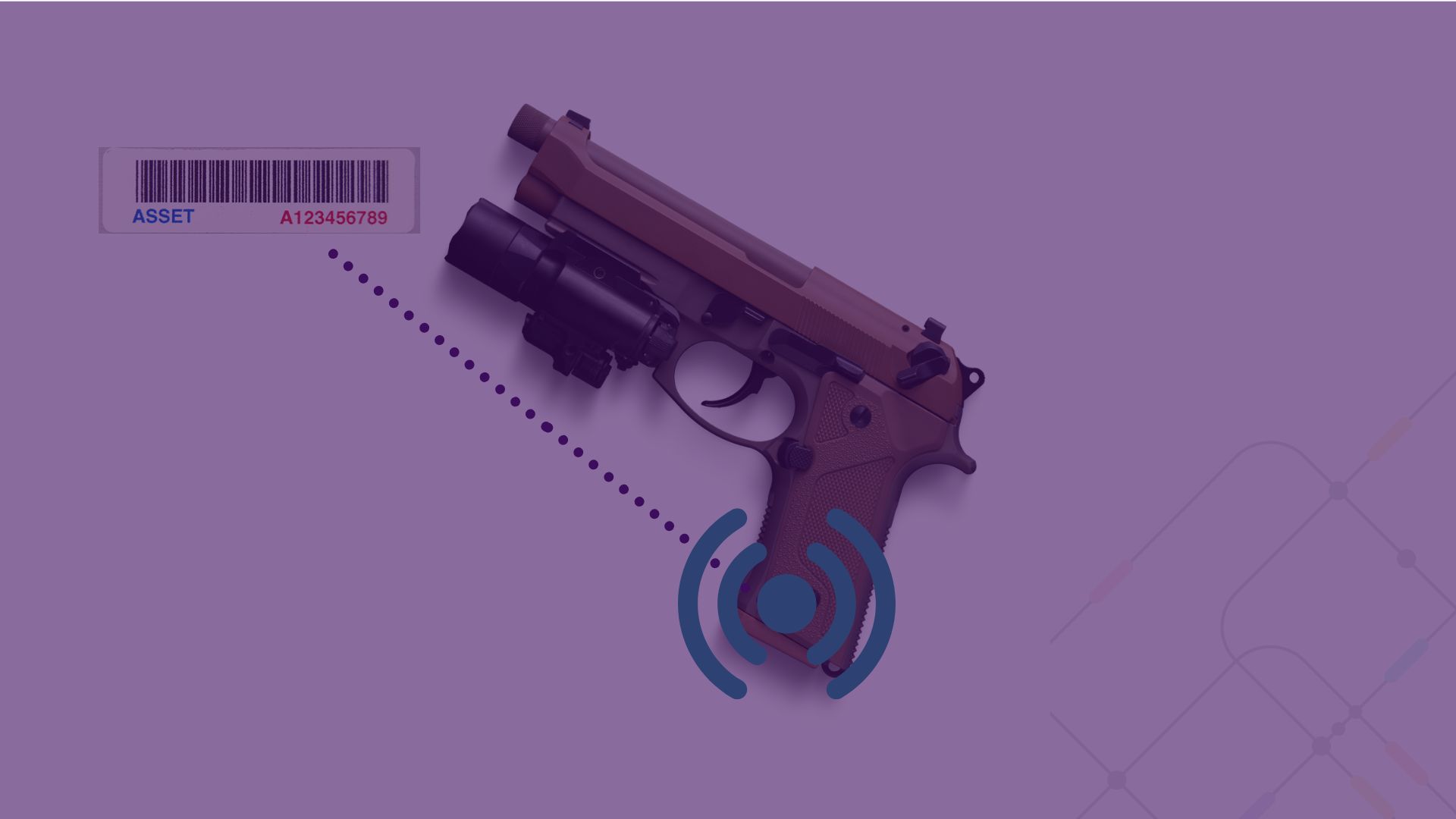
Most conversations about weapon accountability technology focus on
- Large agencies
- State police
- Federal Task Forces
- Multi location city departments
with dedicated armory staff. But the departments that often carry the greatest risk from outdated tracking methods are the smaller ones: municipal police departments and regional offices running an armory with a handful of personnel, juggling multiple responsibilities, and still relying on paper logs or basic spreadsheets to track firearms, tactical gear, and ammunition.
A mid-sized police department in California illustrates exactly this challenge. By deploying passive RFID antennas, handheld readers, and centralized inventory software, the department moved from a manual, paper-bound armory to a fully automated, real-time accountability checkpoint — one that delivers documented improvements in inventory accuracy, slashes issue-return processing times, and keeps the armory audit-ready on demand.
The Hidden Cost of Paper-Based Armories in Smaller Departments
Smaller police stations and offices rarely have the luxury of a dedicated armory team working in shifts. More often, one or two armorers or supervising officers are responsible for an entire inventory of firearms, magazines, tactical equipment, ammunition, and increasingly, drones and other specialty gear — on top of their other duties. In that environment, paper logs and manual serial number checks aren’t just inconvenient; they’re a structural liability.
- No Automated Verification: Assets are checked out by eye, meaning return confirmations depend entirely on whether an armorer manually logs the serial numbers correctly — with no second layer of verification to catch a transcription mistake before it becomes a missing-weapon problem.
- Inventory Drift: Over time, handwritten logs generate missed entries, incorrect numbers, and lost documents, causing physical inventory counts to drift from the recorded data. In a smaller department, where the same one or two people are filling out the log during every shift change, small errors compound quickly and often go unnoticed until an audit forces the issue.
- Shift-Change Bottlenecks: Manual serial number checks force a slow, error-prone line at the armory window, compromising deployment speed — a problem that’s magnified in smaller departments where officers can’t simply route around a backed-up window during a shift change or an emergency callout.
- Siloed Warehouse Operations: Tactical gear, drones, uniforms, and ammunition are tracked on separate systems, leaving the department with zero unified visibility. Smaller offices frequently patch this together with a mix of spreadsheets, index cards, and institutional memory — a system that works only as long as the person who built it stays on staff.
Why This Matters: The Real Risk Behind the Paperwork
A paper-based armory leaves command leadership entirely blind to true asset availability and vulnerabilities. Missing a record or misidentifying a firearm serial number creates dangerous compliance and accountability gaps that cannot be verified after the fact — and for a smaller department, there’s often no backup system or redundant staff to catch the error before it becomes a liability.
When state or federal auditors demand inventory verifications, the process forces departments to halt operations for hours of manual counting. For a larger agency, that might mean pulling staff from other duties for an afternoon. For a smaller department already running lean, it can mean pulling the only armorer off patrol-support duties entirely, or delaying the audit and risking non-compliance. The stakes of a paper system don’t shrink with the size of the department — if anything, they grow, because there are fewer people and fewer safeguards standing between a clerical error and a genuine accountability failure.
The Solution: Automated Accountability at Every Checkpoint

The department’s transition centered on replacing manual entry points with automated verification at every stage of the weapon lifecycle:
- Multi-Class Asset Tagging: Small arms are equipped with adhesive-mounted RFID inlays, tactical drones carry printed RFID tags, ammunition is tracked at case and lot levels, and warehouse consumables use combined barcode-RFID logic — bringing every asset class into a single tracking framework instead of separate, disconnected systems.
- Automated Window Checkpoints: Embedded passive RFID antennas read weapon tags automatically as they pass through the issue window. The system runs an automated credential check, prompts an electronic signature, and updates the live database in under 30 seconds — removing the manual serial-number bottleneck that slows down shift changes.
- Walking-Speed Mobile Audits: Armorers use handheld RFID readers to scan entire rows of racks simultaneously, without requiring line-of-sight or individual serial number handling — a critical capability for departments where one person is responsible for the full audit process.
For a smaller department, this isn’t just a speed upgrade — it’s a way to get enterprise-grade accountability without needing to add enterprise-sized headcount. The system does the verification work that used to depend entirely on one person’s diligence and memory.
Simple to Implement, Even for a Small Inventory
One of the biggest misconceptions smaller departments have about RFID weapon tracking is that it’s a heavy, enterprise-only undertaking — something that requires a dedicated IT team, months of setup, and an inventory large enough to justify the effort. In practice, deploying a system for a smaller armory is a fast, low-disruption process:
- No Rip-and-Replace: RFID inlays are applied directly to existing weapons, magazines, and gear during a single tagging session — there’s no need to replace equipment, change vendors, or interrupt normal issue-and-return operations for more than a day or two.
- Pre-Configured Templates: For a department managing a few dozen to a few hundred weapons, the software ships with ready-to-use categories, permission tiers, and report formats out of the box — there’s no need to build workflows from scratch before going live.
- Minimal Hardware Footprint: A small armory typically needs only a single window-mounted antenna and one or two handheld readers to fully digitize its issue window and audit process — a modest hardware investment relative to the accountability gained.
- Fast Staff Onboarding: Because the interface mirrors the sign-out logic officers already know from paper logs, armorers are typically comfortable running full transactions and audits within a day of training, with no specialized technical background required.
Better Than a Phone Call: Real-Time Notifications Across Every Device
Some smaller departments try to bridge their paper gaps informally — a supervisor texting a photo of a sign-out sheet, or an armorer calling a commander to report a discrepancy. These workarounds depend entirely on someone remembering to send the message, and they leave no searchable, centralized record.
An RFID-based system replaces that informal chain with automatic, rule-based alerts delivered directly to the people who need them:

SMS Alerts
For personnel who need visibility without opening an app — a duty commander in the field, for instance — critical events like a lapsed certification or a mismatched return can trigger an automatic text message.
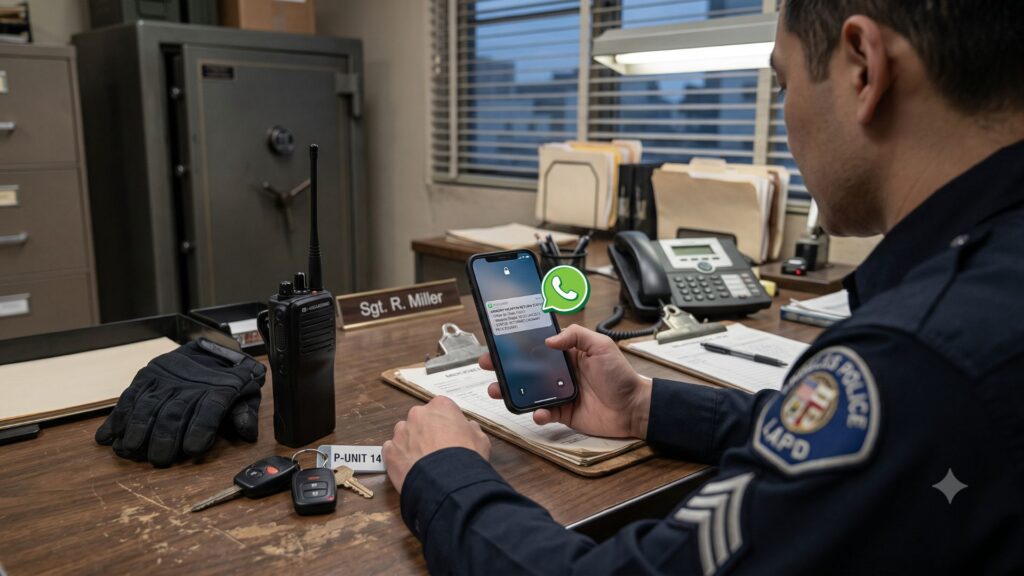
WhatsApp Integration
In departments where WhatsApp is already the default channel for shift coordination, the same alerts can be routed there, meeting staff in the tool they already check throughout the day rather than asking them to adopt a new one.
The difference from an informal phone call or text is consistency: every alert is triggered automatically by the same rule set every time, logged permanently in the system, and delivered to every relevant recipient simultaneously — rather than depending on whether one person remembered to pick up the phone. For a smaller department where the same one or two people are already stretched across multiple roles, that automatic layer of notification is often what closes the last gap between “the paperwork says it’s fine” and “we actually know it’s fine.”
The Results: From Reactive Logs to Weapon Operational Control
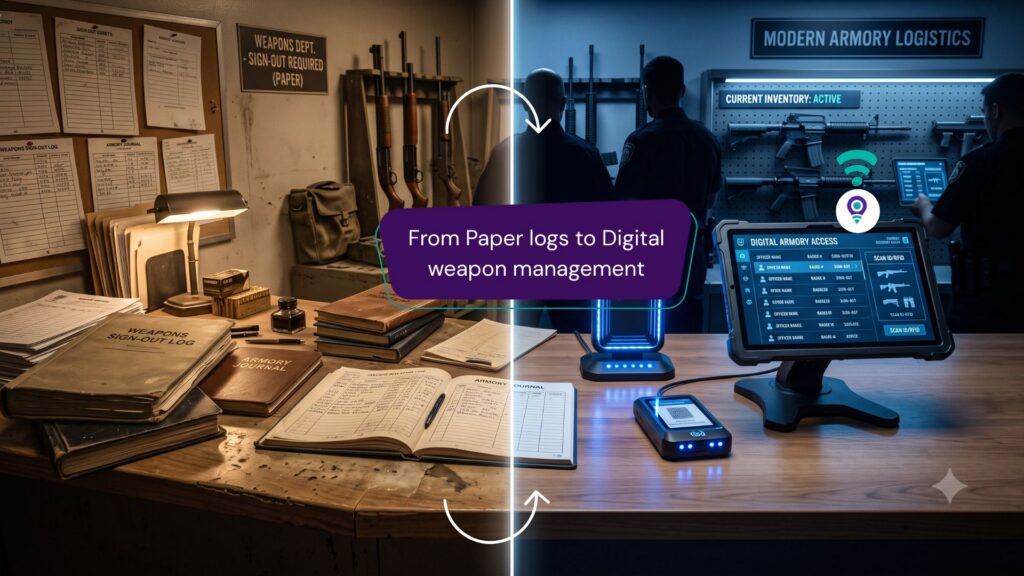
Departments migrate from reactive logs to live, tamper-proof operational control. Full armory audits are slashed from hours to under 10 minutes, generating an automated, three-tier report – Expected & Found, Expected & Not Found, Unexpected & Found, to satisfy state and federal guidelines.
By removing human error at the window, organizations eliminate inventory drift, prevent proxy issuance, and achieve total visibility across all asset classes simultaneously. For smaller departments in particular, the shift means an armory that no longer depends on one person’s handwriting or memory to stay compliant – accountability becomes a function of the system itself, not the staffing level behind it.
Conclusion
This transition shows that RFID-based weapon accountability isn’t only a large-agency solution — it may matter most for smaller departments, where thin staffing leaves the least room for manual error. Moving from paper logs to automated checkpoints closes exactly the gaps that put lean departments at risk: undocumented returns, drifting inventory counts, slow shift changes, and siloed tracking across gear types.
Contact IoTWeaponTracker to learn how a right-sized RFID deployment can bring full armory accountability to departments of any size — without requiring the staff of a major metropolitan force to maintain it.